
ISO/IEC 25010 sets out a quality model for software and IT systems. A new edition has been available since November 2023.
This article introduces the model, explains the changes and shows how you can use the standard to check your software requirements and system tests for completeness.
- ISO/IEC 25010:2023 replaces the 2011 edition. It describes the product quality of software using nine characteristics and 40 sub-characteristics.
- A new characteristic is Safety. ‘Usability’ has been renamed Interaction Capability, and ‘Portability’ has been renamed Flexibility. The Quality-in-use model is now set out in ISO/IEC 25019.
- The standard is not harmonised and is not mandatory. However, it is suitable as a checklist for verifying the completeness of software requirements and system tests, and for demonstrating compliance with the state of the art.
- The attribute Safety does not replace risk management in accordance with ISO 14971. For products involving AI, ISO/IEC 25059 supplements the model.
- There is no normative relationship with IEC 62304. However, the content of its Chapter 5.2.2 is derived from the predecessor standard, ISO 9126.
- Maintainability does not belong in the software requirements, but rather in the development plan and the architecture.
1. What ISO/IEC 25010 is
a) Purpose
ISO/IEC 25010 classifies the quality of a software product into ‘characteristics’ and ‘sub-characteristics’. It does not specify any requirements for a product. Instead, it provides a taxonomy.
You should therefore use the standard as a checklist. Most manufacturers primarily specify and test functionality. The standard serves as a reminder of what else constitutes quality, such as timing behaviour, interoperability, recoverability or installability.
b) Part of the SQuaRE Family
ISO/IEC 25010 forms part of the ISO/IEC 25000 series of standards, ‘Systems and Software Quality Requirements and Evaluation’ (SQuaRE). The following standards are of particular interest to medical device manufacturers:
| Standard | Content |
| ISO/IEC 25010:2023 | Product quality model (subject of this article) |
| ISO/IEC 25019:2023 | Quality-in-use model (Quality in the context of use) |
| ISO/IEC 25012 | Data Quality Model |
| ISO/IEC 25023 | Metrics for Product Quality |
| ISO/IEC 25030 | Quality Requirements |
| ISO/IEC 25059:2023 | Quality Model for AI Systems |
c) Regulatory Status
ISO/IEC 25010 is not harmonised under the MDR, the IVDR or any other regulations. Consequently, those who comply with it cannot invoke the presumption of conformity with the essential safety and performance requirements (GSPR). No one requires you to comply with the standard.
Nevertheless, it is worthwhile. The MDR (Annex I, Section 17.2) and the IVDR (Annex I, Section 16.2) require manufacturers to develop software ‘in accordance with the state of the art’. A quality model that enables you to systematically verify the completeness of your requirements and tests helps to demonstrate this.
2. The Quality Model of ISO/IEC 25010:2023
The model distinguishes between nine quality attributes comprising a total of 40 sub-attributes.
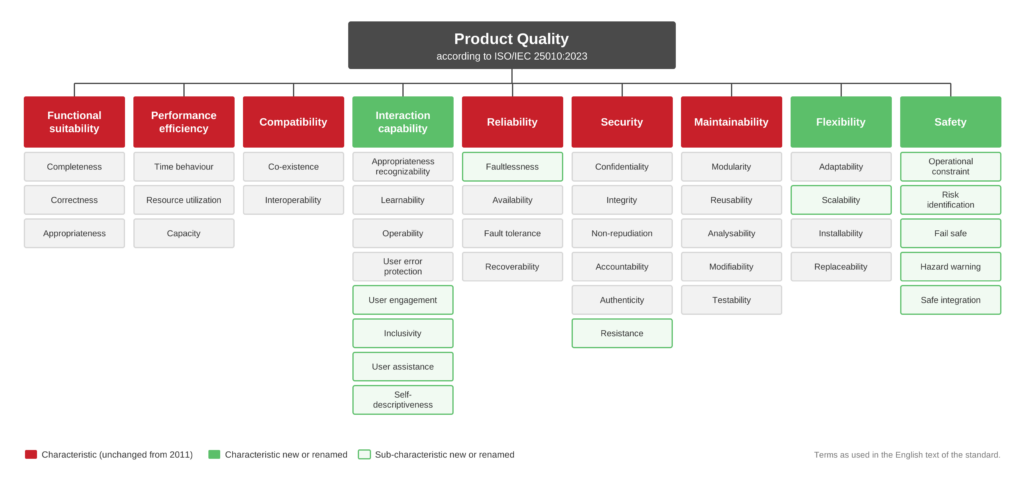
| Characteristic | Sub-characteristics |
| Functional suitability | Completeness, correctness, appropriateness |
| Performance efficiency | Timing behaviour, resource utilisation, capacity |
| Compatibility | Coexistence, interoperability |
| Interaction capability | Recognisability of suitability, learnability, usability, protection against user errors, user engagement, inclusivity, user support, self-descriptiveness |
| Reliability | Faultlessness, availability, fault tolerance, recoverability |
| IT security | Confidentiality, integrity, non-repudiation, accountability, authenticity, resistance |
| Maintainability | Modularity, reusability, analysability, modifiability, testability |
| Flexibility | Adaptability, scalability, installability, interchangeability |
| Safety | Operational constraints, risk identification, fail-safe, hazard warning, safe integration |
Please note the two meanings of ‘security’: Security refers to protection against attacks and unauthorised access, whilst Safety refers to the protection of people, property and the environment from harm. This article therefore uses ‘IT security’ for Security and ‘Safety’ for Safety.
3. What Has Changed Since 2011
ISO/IEC 25010:2023 replaces the first edition from 2011. The structure remains the same. An overview of the changes:
| Characteristic 2011 | Characteristic 2023 | Change |
| Functional suitability | Functional suitability | none |
| Performance efficiency | Performance efficiency | none |
| Compatibility | Compatibility | none |
| Usability | Interaction capability | renamed; „User interface aesthetics“ becomes User engagement; „Accessibility“ is included in Inclusivity and User assistance; new: Self-descriptiveness |
| Reliability | Reliability | „Maturity“ becomes Faultlessness |
| Security | Security | new: Resistance |
| Maintainability | Maintainability | none |
| Portability | Flexibility | renamed; new: Scalability |
| – | Safety | new characteristic with five sub-features |
| Quality-in-use-model | – | moved to ISO/IEC 25019:2023 |
a) New Characteristic: Safety
This new quality attribute describes the extent to which the system prevents situations in which life, health, property or the environment are at risk. The five sub-attributes:
- Operational restriction: The product restricts its operation to safe parameters or conditions when a hazard arises.
- Risk identification: The product detects events or processes that expose life, property or the environment to an unacceptable risk.
- Fail-safe: In the event of a failure, the product automatically switches to a safe operating state or reverts to a safe state.
- Hazard warning: The product warns of unacceptable risks so that users can take appropriate action.
- Safe integration: The product remains safe when combined with other components.
This is nothing new for medical device manufacturers. What is new is that a general software quality model now explicitly mentions these aspects. This is because many IT security requirements have the CIA (Confidentiality, Integrity and Availability) of data and systems as their protection objectives. But not safety.
b) Interoperability Rather Than Usability
The first edition of this article criticised the Usability branch of ISO 9126 and ISO 25010:2011. The reason: ISO 9241-11 and IEC 62366-1 define usability differently.
“The extent to which a system, product or service can be used by specific users in a specific context of use to achieve specific objectives effectively, efficiently and satisfactorily.”
Source: ISO 9241-11:2018
According to this definition, a system with functional faults cannot be fit for purpose. This is because nobody can effectively achieve their goals using it. Functionality would therefore be a sub-aspect of fitness for purpose, not a feature in its own right. However, the old standards used the term usability to refer solely to usability – that is, the characteristics of the user interface.
The 2023 edition resolves this contradiction:
- The product quality model now refers to Interaction Capability. This refers to the properties of the product that enable interaction.
- Usability as defined in ISO 9241-11 forms part of the ‘Quality in Use’ model in ISO/IEC 25019. There, it is part of the characteristic Beneficialness.
This means the terminology is finally consistent with IEC 62366-1.
c) Flexibility Instead of Portability
‘Portability’ becomes Flexibility. A new sub-attribute, Scalability, has been added: How well can the product cope with increasing or decreasing loads, with more users or more data? This is aimed at cloud and SaaS solutions, such as clinical information systems or platforms for remote patient monitoring.
d) Further Changes
- Faultlessness instead of maturity: Faultlessness replaces Maturity. The new term states directly what it is about: the product functions without faults during normal operation.
- Resilience: The new sub-attribute Resistance in IT security describes how well the product maintains its operation whilst under attack.
- Inclusivity and user support: These replace ‘Accessibility’. The standard thus explicitly takes into account users with different abilities, languages and cultural backgrounds.
- Self-descriptiveness: The product makes it clear, without a manual, what it does and how to operate it.
4. Implications for Medical Devices
a) ‘Safety’ Does Not Replace Risk Management
The ‘Safety’ attribute can lead to a false conclusion: that anyone who has formulated a requirement for every sub-attribute has the product’s safety under control. This is not true.
The manufacturer identifies the hazards posed by a medical device and the measures required to control the risks through risk management in accordance with ISO 14971. IEC 62304 also requires an analysis of the software’s contribution to hazardous situations (Chapter 7).
ISO/IEC 25010 provides assistance in another area: it serves as a reminder to formulate the measures defined in the risk management process as software requirements. Typical examples include plausibility checks, alarms, warnings and behaviour in the event of a fault.
b) IT-security and IEC 81001-5-1
Even with regard to the IT security attribute, ISO/IEC 25010 does not replace a threat analysis. This is required by IEC 81001-5-1 as part of a secure software life cycle. However, the sub-characteristics of ISO/IEC 25010 are well suited to checking the security requirements derived from them for any gaps. The new sub-characteristic Resistance draws attention to a question that many specifications leave unanswered: what does the product do whilst an attack is in progress?
Read more about the regulatory requirements for the IT security of medical devices and about IEC 81001-5-1.
c) Products With AI
For products utilising machine learning, ISO/IEC 25010 is not sufficient. ISO/IEC 25059:2023 extends the model to include characteristics typical of AI systems, such as:
- User controllability
- Functional adaptability
- Robustness
- Transparency
- Intervenability
Because the quality of an ML model depends on the quality of the training
Read more about the regulatory requirements for medical devices incorporating machine learning and the AI Act.
5. Interrelation With IEC 62304
a) No Normative Relationship
There is no formal relationship between ISO/IEC 25010 and IEC 62304. IEC 62304 does not require compliance with ISO/IEC 25010.
In terms of content, however, the standards are closely related. The authors of IEC 62304 drew on the predecessor standard ISO 9126 for Chapter 5.2.2 (Content of Software Requirements), and subsequently also on ISO 25010; however, they did not adopt the logic of these standards. Consequently, the chapter mixes functionality, performance, interfaces and the runtime environment, even though these aspects are orthogonal to one another. The 2nd edition of IEC 62304 leaves Chapter 5.2 largely unchanged as things stand today.
The following table maps the contents of Chapter 5.2.2 to the characteristics of ISO/IEC 25010:2023:
| contents in accordance with IEC 62304, Chapter 5.2.2 | characteristic in accordance with ISO/IEC 25010:2023 |
| functional and performance requirements | functional suitability; performance efficiency |
| inputs and outputs of the software system | functional suitability |
| interfaces to other systems | compatibility |
| Software-controlled alarms, warnings and operator messages | safety (hazard warnings), interactivity |
| Security requirements | IT security |
| User interface requirements | interactivity |
| Data and database requirements | functional suitability, reliability (data integrity; also: IT security) |
| installation and acceptance requirements | flexibility (ease of installation) |
| requirements relating to IT network aspects | compatibility, IT security |
| requirements for operation and maintenance by the user | interoperability, flexibility |
| regulatory requirements | (not a separate characteristic) |
Noteworthy: IEC 62304 does not specify a separate category for reliability (e.g. availability, recoverability) and scalability. This is precisely where ISO/IEC 25010 helps to identify gaps in the specification.
b) Testing Via Interfaces
Software requirements should describe the software as a black box: based on its behaviour at the interfaces. Software has three types of interfaces:
- User-system interfaces (UI)
- System-system interfaces (data interfaces)
- Interfaces to the runtime environment (hardware, operating system, libraries)
Check your software requirements against this matrix. An x indicates that the feature is observable at this interface and therefore typically:
| characteristic according to ISO/IEC 25010:2023 | UI | Data interfaces | Runtime environment |
| functional suitability | x | x | |
| performance efficiency | x | x | x |
| compatibility | x | x | |
| interoperability | x | ||
| reliability | x | x | x |
| IT security | x | x | x |
| maintainability | |||
| flexibility | x | ||
| safety | x | x | x |
c) Special Case: Maintainability
Maintainability cannot be assessed via any of the interfaces. It therefore does not form part of the software requirements (Software Requirements Specification).
Nevertheless, it is by no means unimportant. Manufacturers must be able to rectify faults and vulnerabilities quickly, not least to fulfil regulatory obligations regarding cybersecurity. You should therefore define maintainability requirements elsewhere:
- in the software development plan, for example coding guidelines and requirements for static code analysis (IEC 62304, Chapter 5.1)
- in the software architecture, for instance regarding modularity and the interchangeability of SOUP (Chapter 5.3)
- in the acceptance criteria for software units (Chapter 5.5)
6. How to Apply the Standard in Practice
a) Reviewing Software Requirements
Go through your software requirements feature by feature and sub-feature by sub-feature. Ask the following questions for each one:
- Are there any requirements for this sub-feature?
- If not: Has this been a deliberate decision, and is it justified?
- If so: Are the requirements formulated in a verifiable manner, i.e. with values and conditions?
Not every sub-feature requires a requirement. However, the decision to omit one should be a deliberate one.
The following table shows examples for an app that calculates an insulin dose:
| characteristic (sub-characteristic) | example requirement (simplified) |
| Functional suitability (correctness) | The app calculates the bolus according to Formula F-1 and rounds down to 0.5 IU. |
| Performance efficiency (timing) | The app displays the result no later than 1 s after the last input. |
| Compatibility (interoperability) | The app retrieves glucose readings from the CGM system via interface S-2 in accordance with its specification. |
| Interoperability (protection against user errors) | The app rejects glucose readings outside the range of 20 to 600 mg/dl with a warning. |
| Reliability (recoverability) | Following a crash, the app restores the most recently entered values. |
| IT security (confidentiality) | The app stores health data in encrypted form in accordance with the K-1 cryptographic concept. |
| Flexibility (installability) | The app can be installed on all operating system versions approved in Document D-3. |
| Safety (hazard warning) | If the calculated dose exceeds the stored daily maximum, the app issues a warning and requires confirmation. |
b) Reviewing system tests
The same review is worthwhile for system tests (IEC 62304, Chapter 5.7). Many test plans cover functionality thoroughly but neglect load testing, recovery from faults, installation tests or tests under attack. A ‘sub-attribute × test case’ matrix highlights such gaps.
c) Making requirements measurable
ISO/IEC 25023 proposes metrics for many sub-characteristics, for example for availability or response times. This helps to formulate requirements in such a way that compliance can be verified.
ISO/IEC 9126 (1991, Part 1 revised in 2001): The first widely used quality model with six attributes (functionality, reliability, usability, efficiency, maintainability, portability)
ISO/IEC 25010:2011: Replaces ISO 9126. IT security and compatibility are now included as separate attributes, having previously been part of functionality. A ‘quality-in-use’ model has also been added.
ISO/IEC 25010:2023: New attribute: Safety; renaming; the ‘quality-in-use’ model has been moved to ISO/IEC 25019
The distinction between functional and non-functional requirements dates back to the days of ISO 9126. Unfortunately, it is rarely helpful in practice.
7. Conclusion
ISO/IEC 25010 is not mandatory. However, it is one of the best checklists available for software requirements and system testing.
The 2023 edition makes it even more useful for medical device manufacturers: the new Safety attribute addresses warnings and safe states. The new terminology for interaction aligns with IEC 62366-1. And scalability is becoming important, as more and more medical devices are running in the cloud.
You should therefore check whether your templates and checklists are still based on ISO 9126 or the 2011 edition. If so, update them.
Support from the Johner Institute
- In Auditgarant, video training modules teach you how to formulate software requirements in a way that is compliant with IEC 62304 and verifiable. The templates save you a great deal of work.
- In the “Compact Seminar on Medical Software”, you will acquire the required competencies for software development.
- Do you have any questions about your software requirements? Then make use of the free Micro-Consulting service.
Change history
- 2026-11-25: Article translated
- 2026-11-19: Article (German) completely revised. Among other things, ISO 9126 was largely removed and an update to ISO 25010 was included
- 2015-08-10: Last documented update of article (German)