
The European Packaging and Packaging Waste Regulation (PPWR) introduces far-reaching new requirements for packaging in the EU. For manufacturers of medical devices and in vitro diagnostic medical devices (IVDs), the main question is whether the new rules also apply to sterile, protective, or contact-sensitive packaging. The answer is nuanced:
Medical devices and IVDs are generally covered by the regulatory framework; however, the PPWR provides for exceptions for certain types of packaging. For Regulatory Affairs, Quality Management, and Packaging Development, this means carefully assessing which packaging is subject to which requirements and identifying potential synergies with Regulation (EU) 2017/745 on medical devices and Regulation (EU) 2017/746 on in vitro diagnostic medical devices (MDR/IVDR).
1. Applicability and Relevance of the PPWR
a. Are medical devices and IVDs affected by the PPWR?
In short: yes, but not to the same extent for every type of packaging for a medical device or IVD.
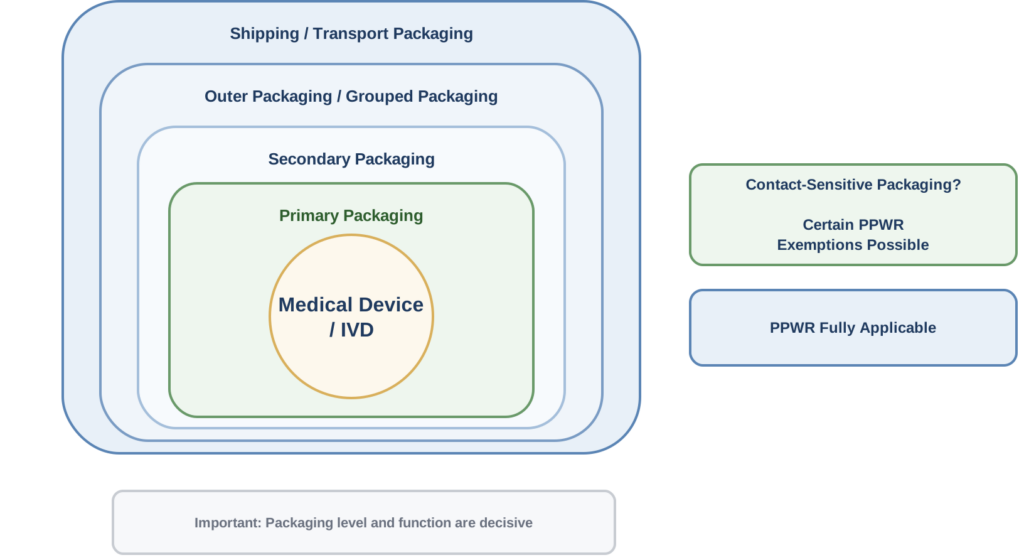
The PPWR does not focus on the medical device itself, but rather on the respective packaging level and its function. A single product can have multiple packaging levels, such as:
- Sterile primary packaging
- Secondary packaging
- Outer packaging
- Shipping or transport packaging
It is precisely this differentiation that determines whether exemptions apply or whether the general PPWR requirements are fully applicable.
b. Relevance of the PPWR for Medical Devices and IVDs
The PPWR is gradually replacing the previous European legal framework for packaging and packaging waste. Directive 94/62/EC was repealed effective August 12, 2026; at the same time, transitional provisions continue to apply to certain topics.
For manufacturers of medical devices and IVDs, the regulation is relevant simply because it comprehensively regulates packaging, regardless of the industry in which it is used. The definition of “packaging” is broad and describes items used to contain, protect, handle, deliver, and present products.
Definition of the Term “Packaging”
“Packaging” [is an] article, regardless of the materials from which it is made, intended for use by an economic operator to contain or protect, handle, deliver, or present products to another economic operator or to an end user, and which, based on its function, material, and design, can be differentiated by packaging format, including
- a) an item that is necessary to contain, support, or preserve a product throughout its entire life cycle, without being an integral part of the product, and that is intended to be used, consumed, or disposed of together with the product;
- (b) a component or accessory of an item referred to in subparagraph (a) that is integrated into the item;
- (c) an accessory of an item referred to in subparagraph (a) that is directly attached to or affixed to the product, performs a packaging function without being an integral part of the product, and is intended to be used, consumed, or disposed of together with the product;
- d) an item designed and intended for filling at the point of sale for the purpose of dispensing the product, also known as “service packaging”;
- e) a single-use item that is sold and filled at the point of sale or is intended and designed for filling at the point of sale and that serves a packaging function;
- f) a permeable tea or coffee bag, or a permeable bag for another beverage, or a single-serving unit for a tea or coffee system or a system for another beverage that softens upon use, which is intended to be used with the product and disposed of together with it;
- g) an impermeable single-serving unit for a tea or coffee system or a system for another beverage, which is intended for use in a machine and which is used and disposed of together with the product;
(PPWR Art. 3(1))
Roles in Packaging Law
At the same time, it is important in practice that the PPWR does not focus solely on the manufacturer as defined by the MDR/IVDR. Rather, the respective packaging and the company’s role in the specific supply and distribution chain are also decisive. As a result, the obligations relevant under packaging law may differ from the manufacturer’s role under medical device law.
For practical implementation, it is important to distinguish between these two roles. Depending on the supply and distribution chain, the following roles may be particularly relevant:
any natural or legal person who manufactures packaging or a packaged product; however, a) “manufacturer” means, subject to subparagraph b, the natural or legal person who develops or has manufactured packaging or a packaged product under their own name or brand, regardless of whether other brands appear on the packaging or the packaged product; b) “manufacturer” means the natural or legal person who supplies the packaging if the natural or legal person who has the packaging or packaged products designed or manufactured under their own name or brand falls under the definition of a microenterprise applicable as of February 11, 2025, in accordance with Recommendation 2003/ 361/EC, and if the natural or legal person supplying the packaging to the natural or legal person who has the packaging designed or manufactured under their own name or brand is established in the same Member State;
(PPWR Art. 3(13))
any natural or legal person who supplies packaging or packaging material to a producer;
(PPWR Art. 3(16))
any natural or legal person established in the Union who places packaging on the market from a third country;
(PPWR Art. 3(17))
It is also important to note in practice that the “manufacturer” within the meaning of the PPWR is not automatically the manufacturer of the medical device or IVD. Rather, depending on the circumstances, the manufacturer within the meaning of the PPWR may be the producer, importer, or distributor.
Determining the Role
The role a company assumes is not determined solely by who is the manufacturer of the medical device or IVD within the meaning of the MDR/IVDR. Rather, the decisive factor is who, in the specific circumstances and in the respective Member State, first makes the packaging or the packaged product available or otherwise assumes a role relevant under packaging law.
The PPWR should therefore not be viewed in isolation. Although it is closely related to the MDR/IVDR, it follows its own regulatory logic. For companies in the medical technology sector, this means that packaging compliance will no longer be treated solely as a logistical or technical issue, but rather as a distinct regulatory area with intersections with market surveillance, supplier management, and sustainability.
c. Exemptions for Medical Devices and IVDs
A key point is that the PPWR includes exemptions in certain regulatory areas for contact-sensitive packaging of medical devices and IVDs.
Packaging intended for use with products falling within the scope of Regulations […] (EU) 2017/745, (EU) 2017/746 […] or the Directives […]
(PPWR Art. 2(49))
In practice, it is important to note: Not every package of a medical device or IVD is considered contact-sensitive simply because it is part of a regulated product. Rather, the specific function of the respective packaging level is decisive.
In practice, this means:
- Not every package of a medical device or IVD is automatically exempt.
- It is particularly relevant whether the specific packaging level in question constitutes contact-sensitive packaging.
- The function of the respective packaging level in the specific context of use is decisive.
- Secondary packaging, bundle packaging, or transport packaging may still be fully subject to the general PPWR requirements.
- It is therefore necessary to assess, for each packaging level, which requirements apply and whether an exemption is actually applicable.
2. PPWR Requirements for Medical Devices and IVDs
Even though individual packaging items may be exempt, the PPWR remains highly relevant for medtech companies in several areas.
a. Conformity of Packaging
The regulation provides for a separate conformity assessment procedure for packaging. Packaging thus becomes a standalone compliance object, the conformity of which must be demonstrated and documented.
This means:
- Packaging requirements must be systematically identified.
- The results must be technically evaluated and recorded in robust documentation.
- On this basis, an EU Declaration of Conformity must be provided for the respective type of packaging.
In practice, this means that the evidence, evaluations, and specifications relevant to the respective packaging must be compiled into structured technical documentation.
b. Information Requirements in the Supply Chain
Suppliers of packaging or packaging materials must provide the manufacturer with the information and documentation needed to demonstrate compliance.
This is particularly important for medical device manufacturers, as packaging components often come from specialized suppliers. Without reliable material and compliance data, it is virtually impossible to efficiently implement PPWR requirements.
c. Recyclability
The PPWR places a strong emphasis on the recyclability of packaging. As of January 1, 2030, or a later date to be determined by legislation yet to be enacted, packaging may only be placed on the market if it is recyclable in accordance with the specified performance levels.
This is particularly challenging for the medtech industry because packaging often
- consists of composite materials,
- requires barrier properties,
- must ensure sterility,
- and must meet high standards for product protection and validatability.
d. Recycled Content in Plastic Packaging
The PPWR aims to increase the use of recycled plastic. At the same time, it includes important exemptions for certain sensitive packaging, including contact-sensitive plastic packaging for medical devices and IVDs.
This means:
- Recycled content requirements do not apply across the board to every packaging level.
- The packaging portfolio must be analyzed on a case-by-case basis.
- Each exemption must be carefully justified.
e. Labeling
Labeling requirements also play a major role. In the future, packaging must carry additional information, such as details on material composition or disposal. For medical devices and IVDs, however, it is important that the PPWR takes into account existing labeling requirements under the MDR/IVDR.
For companies with complex packaging hierarchies and long product life cycles, this is particularly relevant from an operational standpoint, for example regarding
- label management,
- language versions,
- inventory levels, and
- sales strategies.
f. Administrative Obligations
An often-underestimated aspect of the PPWR is the administrative obligations that go beyond material and design requirements. Especially for manufacturers of medical devices and IVDs operating in multiple EU member states, registration, reporting, and financing obligations will play a greater role in the future.
The manufacturer of a medical device or IVD is not automatically the party subject to packaging regulations.
One point is particularly important in practice: the term “manufacturer” is not used identically in the MDR/IVDR and the PPWR. For registration, EPR, and reporting obligations under packaging law, the decisive factor is the role a company assumes in the supply and distribution chain. Accordingly, the MD/IVD manufacturer is not necessarily also responsible for registration, EPR, and reporting obligations in every case. Rather, what matters is who first makes packaging or a packaged product available in the relevant constellation and in the respective Member State.
In practice, this means for medical device and IVD companies: The role of manufacturer under medical device law is only the starting point. Additionally, for each country and distribution model, it must be determined which role the company actually assumes under packaging law—for example, as a producer, importer, or in another role relevant under national packaging law.
Manufacturer Register
The PPWR requires each Member State to maintain a national register of obligated parties. Registration obligations apply to the role that is relevant under packaging law in each case. Companies must therefore determine, for each Member State, whether they are making packaging or packaged products available for the first time within that territory, importing them, or otherwise assuming a role subject to registration.
This is particularly relevant for medtech companies if
- they distribute medical devices or IVDs directly in multiple EU countries,
- they act as importers, or,
- depending on the Member State, distribution model, or packaging level, they assume different roles under packaging law.
Extended Producer Responsibility (EPR)
The PPWR closely links packaging regulation with extended producer responsibility. Put simply, this means that anyone who places packaging on the market must, in principle, also contribute to the costs of collecting, sorting, and recycling packaging waste.
For companies, this means in particular:
- Participation in national EPR systems
- Volume reporting per member state
- Financing obligations
- Ongoing documentation and reporting obligations (depending on national implementation)
National Reporting Systems
Although the PPWR establishes a harmonized European framework, the practical implementation of many EPR and registration obligations continues to be carried out through national systems. Companies must therefore expect that
- registration procedures are organized differently from country to country,
- deadlines and reporting channels vary by country, and
- different competent authorities are involved.
In practice, this means that a purely centralized EU approach is not sufficient. A country-specific compliance strategy is required. In the case of cross-border direct supply to end users in another Member State, it must also be assessed whether an authorized representative for extended producer responsibility has been appointed.
g. Why This is Particularly Important for Medical Device Manufacturers
Many medical device manufacturers already have established processes for:
- UDI and product registration
- Market surveillance
- Technical documentation
- Vigilance
- Supplier management
These structures are helpful for the PPWR but do not replace the EPR and registration obligations. Rather, it is necessary to assess how packaging data, the allocation of roles, and reporting processes can be integrated into existing regulatory and quality systems.
3. Timelines
Several deadlines are relevant for strategic planning.
- August 12, 2026: The previous Packaging Directive 94/62/EC was repealed effective August 12, 2026; certain provisions remain in effect on a transitional basis.
- August 12, 2028: August 12, 2028, applies to certain labeling and collection requirements, or a later date if the underlying implementing acts are not adopted until then.
- January 1, 2030: As of January 1, 2030, key requirements—such as those regarding the recyclability of certain packaging—as well as restrictions on certain packaging formats will take effect.
- January 1, 2035: 2035 is a key date for reviewing individual exemptions and other requirements related to large-scale recycling.
- January 1, 2038: Starting in 2038, recyclability requirements will be further tightened.
In addition to the material requirements, manufacturers must also keep an eye on the administrative deadlines for implementation. As soon as national registries and reporting systems become operational, companies must register in a timely manner, establish processes for data reporting, and clarify internal responsibilities.
An early start is therefore crucial, especially for regulated products with long change cycles and complex distribution structures.
4. Practical Implementation of the PPWR
a. Segment the Packaging Portfolio
The first step is a clear classification of all packaging:
- Primary packaging
- Contact-sensitive packaging
- Secondary packaging
- Transport packaging
- Plastic packaging
- Composite packaging
b. Review Roles and Countries
In addition, companies should clearly define their role in each Member State. Are they:
- Producer
- Importer
- where applicable, an authorized representative for extended producer responsibility, in particular in cases of cross-border direct supply to end users in other Member States
A medical device manufacturer based in Germany places a medical device on the market under its own name. It sells the device directly to customers in Germany and through a local distributor in Spain, who uses additional shipping packaging.
From the perspective of the MDR/IVDR, the company remains the manufacturer of the medical device in all cases. Under packaging law, however, it may assume different roles depending on the country and the packaging level:
- In the case of direct sales in Germany, the medical device manufacturer may also be the party subject to obligations under the PPWR, particularly if it is the first to make the packaged product available on the national market.
- When distributing through a distributor in Spain who adds additional shipping packaging, the distributor may itself become the obligated party with respect to that packaging level, while the medical device manufacturer remains responsible for other packaging levels.
This makes it clear: The same company may be the manufacturer throughout under the MDR/IVDR, but under packaging law, it does not assume the same role in every country or for every packaging level.
c. Conduct a PPWR Gap Assessment
A structured assessment based on the PPWR topics is recommended:
- Substance and material data
- Packaging weight and minimization
- Recyclability
- Recycled content
- Labeling
- Technical documentation
- Registration and reporting requirements
- Supplier information
- Need for changes to specifications and quality agreements
d. Involve Suppliers Early
The requirements for data and documentation will depend heavily on the suppliers. Suppliers should therefore be involved early on, for example through:
- Technical data sheets
- Material declarations
- Compliance statements
- Contracts and quality agreements
- Change notification processes
e. Bringing Together Packaging Engineering, RA, QM, and Environmental Compliance
The PPWR is not purely a sustainability issue. For medical devices and IVDs, it always also concerns:
- Product safety
- Regulatory approval
- Technical performance
- Process validation
- Market availability
- Environmental registration, reporting, and documentation requirements
An interdisciplinary team comprising Packaging Engineering, Regulatory Affairs, Quality, Purchasing, Logistics, and Environmental/EPR Compliance is therefore the best approach.
g. Leveraging Synergies with MDR/IVDR
The PPWR is new, but it applies to organizations that are already familiar with structured regulatory processes. This is precisely where important synergies lie.
Technical Documentation
Manufacturers of medical devices and IVDs are already accustomed to structuring and maintaining technical documentation and presenting it in a robust manner to Notified Bodies or regulatory authorities. This is precisely where an important synergy with the PPWR lies. For packaging as well, the applicable requirements must be clearly identified, evaluated, and documented.
In practice, this means that companies must systematically compile the information relevant to the respective packaging. This includes, in particular:
- Description of the packaging and its intended use
- Information on structure, components, materials, and manufacturing characteristics
- Technical documentation, drawings, or specifications, to the extent necessary for understanding the packaging design
- An overview of the underlying standards, specifications, and other technical evaluation criteria
- Justification of how the relevant PPWR requirements are met and which solutions were selected to achieve this
- A presentation of the evaluations, tests, and other evidence conducted
For a medical device or IVD, packaging compliance under the PPWR can be documented within the existing technical documentation or in the QM/regulatory document management system, for example as:
- A dedicated section within the MDR/IVDR technical documentation,
- A separate annex or appendix package accompanying the technical documentation
- A standalone packaging compliance dossier with cross-references
Which structure is appropriate depends primarily on the product portfolio, packaging complexity, and organizational structure. What matters most is not so much the formal filing system as the fact that the packaging-related evidence is complete, up-to-date, consistent, and easily traceable for evaluation, audits, and market surveillance.
Risk Management
There are also clear synergies between the PPWR and the MDR/IVDR when it comes to risk management. Although the PPWR does not establish a standalone risk management system like the MDR/IVDR does in conjunction with ISO 14971, it effectively requires that packaging be systematically evaluated, justified, and documented. For medical devices and IVDs, manufacturers can therefore use existing methods such as packaging FMEA or other partial risk analyses and expand them to include PPWR-relevant aspects.
In this way, the assessment of product protection, sterility, storage, transport, and material suitability—already established under the MDR/IVDR—can be integrated with additional PPWR perspectives, such as packaging minimization, recyclability, material selection, substance restrictions, labeling, and data availability in the supply chain. This approach does not result in a separate, isolated second system, but rather in an expanded assessment framework for packaging that balances product safety, regulatory compliance, and environmental requirements.
Supplier Management
The MDR and IVDR also require robust supplier control. These structures can be expanded to address PPWR issues, particularly regarding material and conformity data.
PMS and Market Surveillance
Packaging-related complaints, loss of sterility, transport damage, or material anomalies can be relevant not only from a product perspective but also from a PPWR perspective. Existing PMS and market surveillance processes can therefore be usefully expanded.
Registration and Governance Structures
Companies that already manage Europe-wide registration and reporting obligations under the MDR/IVDR are often well-positioned to set up PPWR registration and EPR processes in a structured manner. However, the respective packaging roles and national responsibilities must be assessed separately.
5. Conclusion and Summary
a. Specific Next Steps for Medical Device and IVD Manufacturers
The most important message is: Waiting is not a good strategy. Proceed as follows:
- Create a packaging inventory
- Classify packaging according to PPWR relevance and exemptions
- Determine roles by country and distribution model; in particular, examine the differences between the MDR/IVDR manufacturer role and PPWR-relevant packaging roles
- Request supplier data and evidence of conformity
- Establish a structure for packaging-related technical documentation and record-keeping
- Identify registration and EPR obligations for each Member State (based on the specific supply and distribution chain)
- Assess interactions with the MDR/IVDR
- Develop a packaging and compliance roadmap through 2028/2030/2035/2038
- Establish monitoring of standards and legislative acts
b. The PPWR is also a strategic regulatory issue
The PPWR will profoundly change the packaging landscape in Europe, including in the medical device and IVD industries. Although the regulation contains important exemptions, particularly for certain contact-sensitive packaging of medical devices and in vitro diagnostic devices, this does not mean that manufacturers can sit back and relax.
In addition to design, material, labeling, and documentation requirements, EPR, manufacturer registries, and national reporting systems are also gaining significant importance. Manufacturers must therefore reassess not only their packaging technology but also their roles, data flows, and reporting processes.
Those who start early can not only reduce compliance risks but also leverage synergies between regulatory affairs, quality management, supplier management, and sustainable packaging development.
Would you like to know which of your packaging products fall under the PPWR, where exemptions for medical devices or IVDs apply, and which EPR or registration requirements are relevant in your target markets? The Johner Institute can assist you with regulatory classification, gap analysis, structuring packaging-related technical documentation, and practical implementation in conjunction with the MDR/IVDR.
Version history:
- 2026-11-18: Section 2(f): clarification of extended producer responsibility; Section 4(b): revision of the practical example