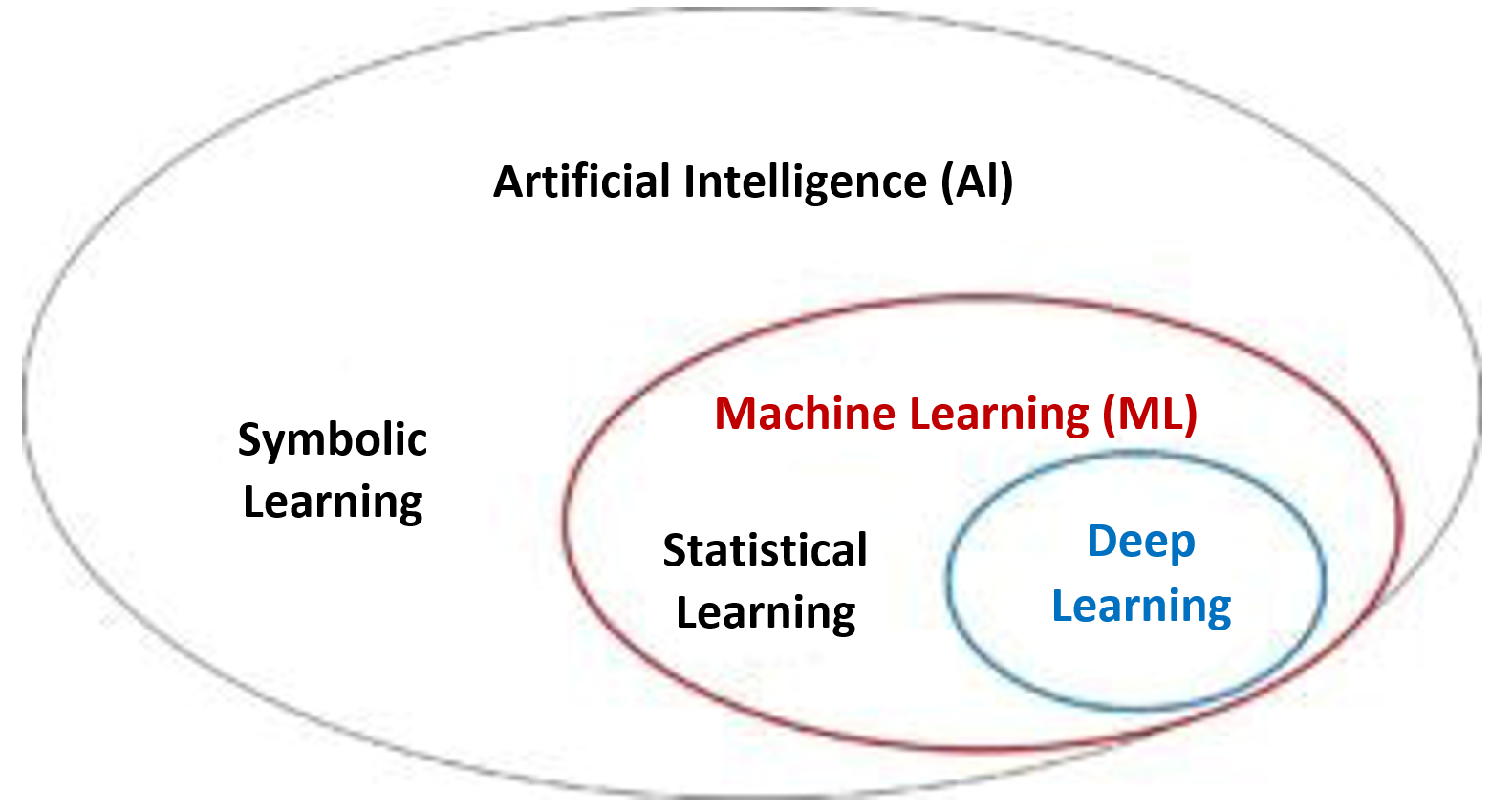
Deep learning is part of machine learning and is based on neural networks (see Fig. 1).
Definition: Deep Learning
“The ability for machines to autonomously mimic human thought patterns through artificial neural networks composed of cascading layers of information.“
Source: i.a. HCIT Experts
This gives us the following taxonomy:
Fig.. 1: Artificial intelligence is based on numerous procedures, of which machine learning is only one part. Neural networks and, thereby, deep learning, are part of machine learning.
b) Definition of the EU
The EU defines the term “AI system” in the AI Act:
“An AI system is a machine-based system designed to operate with varying levels of autonomy and that may exhibit adaptiveness after deployment and that, for explicit or implicit objectives, infers, from the input it receives, how to generate outputs such as predictions, content, recommendations, or decisions that can influence physical or virtual environments.”
AI Act, Article 2 (Definitions), Section 1
This definition reveals three conditions that make a “machine-based system” an “AI system“:
condition
comment
designed to operate with varying levels of autonomy
The word “varying” is vague, so that this condition hardly restricts what falls under this definition.
may exhibit adaptiveness after deployment
The word “may” means that this adaptability can exist but does not have to. This partial condition, therefore, does not restrict what falls under this definition.
infers, from the input it receives, how to generate outputs …
The system derives how it generates the outputs from the inputs. So, it is not a question of the system deriving the outputs from the inputs, but how (i.e., the way?) it does this.
Conclusion: It seems that only the third condition effectively defines what an AI system is. And this condition is difficult to understand.
Example
In a neural network (NN), the inputs do not determine the way in which the outputs are generated. That is because this is already predetermined by the architecture of the NN and the weights and biases of the neurons before an input reaches the system.
The inputs, on the other hand, determine the outputs. But that is also the case with any conventional software algorithm.
2. Articles on the regulatory requirements for AI-based medical devices
Several articles discuss the regulatory requirements for medical devices and IVD that use artificial intelligence procedures, such as machine learning, and provide tips for implementation:
Online courses in the Medical Device University guide manufacturers on their way to “AI-Act-compliant” medical devices and IVD.
The experts at the Johner Institute specialize in developing a regulatory strategy that allows you, as a manufacturer, to bring your AI-based devices to market worldwide as quickly and flexibly as possible. Contact us right here
For manufacturers, the answer to whether and when clinical studies are necessary when using artificial intelligence in medical devices is relevant. After all, the duration and cost of bringing these devices to market depend on this. The good news in advance: there are cases where manufacturers can avoid clinical studies for devices with AI. This…
More and more manufacturers are using machine learning libraries, such as scikit-learn, Tensorflow, and Keras, in their devices as a way to accelerate their research and development projects. However, not all manufacturers are fully aware of the regulatory requirements that they have to demonstrate compliance with when using machine learning libraries or how best to…
You are currently viewing a placeholder content from reCAPTCHA. To access the actual content, click the button below. Please note that doing so will share data with third-party providers.