Digital transformation of notified bodies
The digital transformation of notified bodies will transform the medical device ecosystem over the next few years. This article describes

Before manufacturers place a medical device on the market in the EU, they must undergo a conformity assessment procedure (not quite correctly referred to as an approval procedure).
Content
This page provides a quick overview and contains links to relevant articles.
The objective of conformity assessment is for medical device manufacturers to evaluate (themselves!) the conformity of their devices with the general safety and performance requirements of the EU medical device regulations (MDR and IVDR) and, if successful, to declare conformity – with a declaration of conformity.
“conformity assessment’ means the process demonstrating whether the requirements of this Regulation relating to a device have been fulfilled;”
Manufacturers must involve a notified body in the conformity assessment except for class I devices.
Depending on the class of the medical device, manufacturers can select a suitable conformity assessment procedure (see Fig. 1).
The following table provides an overview of these conformity assessment procedures:
| Description of the procedure | MDR, IVDR |
| Manufacturer sets up a complete QM system and has it certified according to ISO 13485 and the Annex (see right) | Annex IX |
| Manufacturer prepares technical documentation and declares conformity | Annex IV |
| Manufacturer has prototype tested by notified body | Annex X |
| Manufacturer sets up a QM system for production | Annex XI part A |
| Manufacturer has every device produced tested by notified body | Annex XI part B |
| Manufacturer establishes quality assurance (final inspection) | — |
Compared to the now obsolete EU MDD Directive, the EU MDR and IVDR regulations no longer have a conformity assessment procedure for production based solely on the final testing of devices.
Fig. 1 shows which conformity assessment procedure manufacturers may choose depending on the class of the medical device.
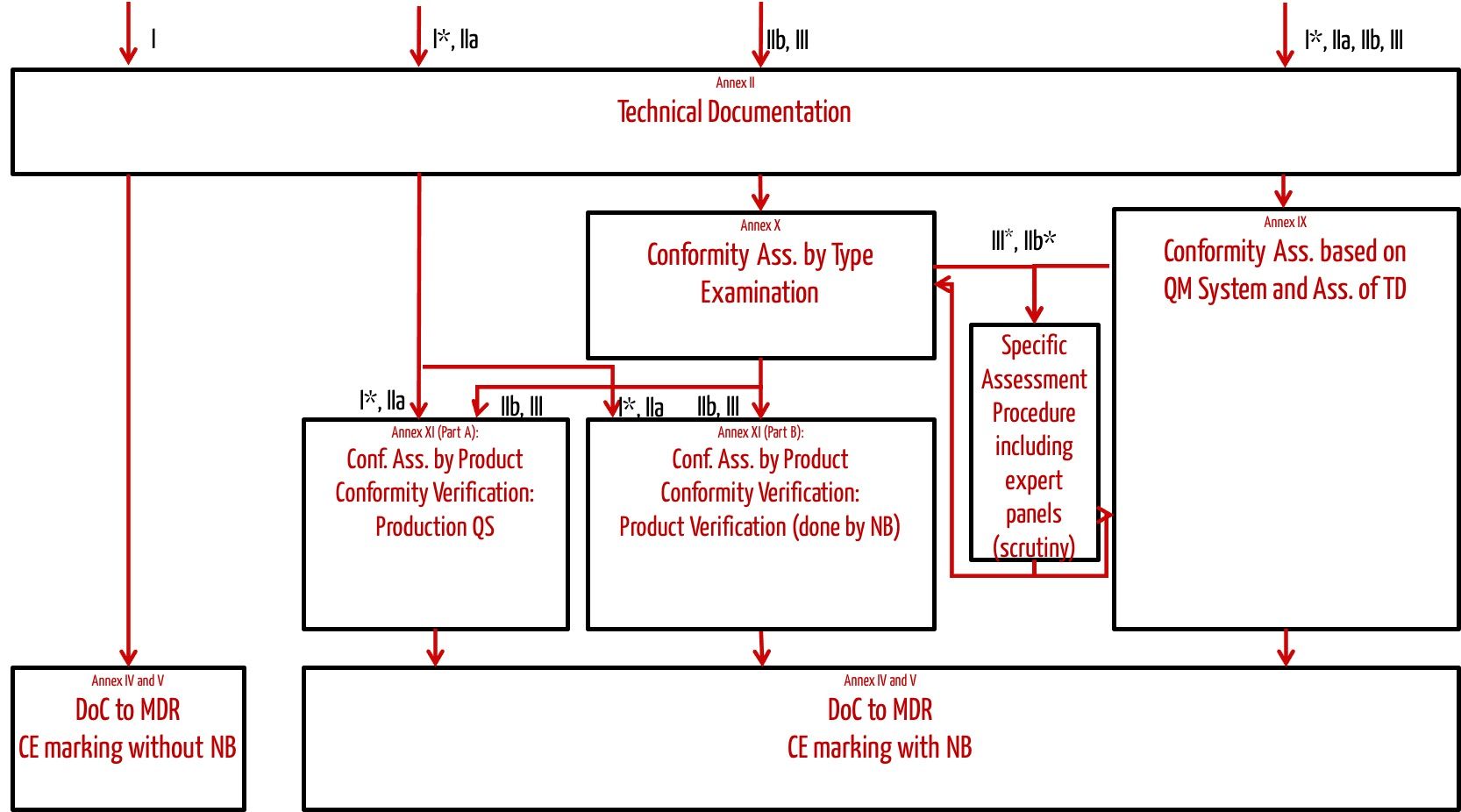
Fig. 1: Conformity assessment procedures specified by the MDR
The most frequently used conformity assessment procedure is the one according to Annex IX of the MDR, which requires the manufacturer to have a certified(!) quality management system.
The IVDR has analogous requirements for in vitro diagnostic medical devices. Read more about the conformity assessment procedures for IVDs here.
The conformity assessment procedure leads to the CE mark. Manufacturers get there in seven steps:
The following presentation shows these steps.
Fig. 2: Presentation “Conformity assessment procedure: 7 steps to the CE mark”. Click to open
Another article outlines the process from the initial idea to the device launched on the market.
The term conformity assessment is often equated with the terms approval and certification, but this is not correct:
To prove that a device meets the general safety and performance requirements and is therefore compliant, manufacturers should use:
Manufacturers need a certificate if a notified body is involved in the conformity assessment. The article “Request versus application for certification” is helpful.
Further articles concern specific conformity assessment procedures:
Some articles are relevant for individual product classes:
Do you have questions about conformity assessment? Then, benefit from our free micro-consulting.
The experts at the Johner Institute specialize in supporting manufacturers in quickly bringing their medical devices to market and in compliance with the law. From the initial idea to the QM audit to the CE mark:
The Medical Device University is recommended for those who prefer to take the path largely without outside help. On this e-learning platform, you will learn how to complete all the above tasks step by step using customized video training. You will also receive a complete set of templates and sample templates.
Contact us now to find the quickest way to obtain a CE mark for your medical device.
The digital transformation of notified bodies will transform the medical device ecosystem over the next few years. This article describes
The Medical Device Coordination Group (MDCG) is an expert panel required by the MDR and IVDR. The MDCG is sometimes confused with another coordination group or with expert panels. You can find out how these groups are differentiated here. Read this article to find out how you are affected by the output of the MDCG’s…
DetailsBoth European and U.S. regulations place requirements on the labeling. However, the two legal systems do not understand the term entirely identically. Even the spelling differs: labeling in the USA, labelling in Europe. In this article, you will learn what you need to keep in mind in each case when it comes to labeling. Speaking…
DetailsWhat a lot of people understand by accessories is different from the definition of the term in the German Medical Device Act (MPG). This article gives you an overview of the definition of the term, the regulatory requirements, and typical questions.
DetailsMedical device manufacturers are obliged to observe and comply with legal retention periods for documents and records. This article provides an overview of the regulatory requirements for the retention periods for the various document classes.
DetailsThe cognitive walkthrough is one of many methods for testing the usability of products. There are many others. An overview of these methods, particularly those for validation of usability, can be found here.
Details