
ISO/TS 24971-2:2026 specifies for the first time how manufacturers should apply ISO 14971 to machine learning components in AI-based medical devices and IVDs.
Although this Technical Specification is not directly binding, it is likely to quickly become an important reference for manufacturers, Notified Bodies, and regulatory authorities.
This article explains what the standard requires, how it is structured, where its strengths lie—and what manufacturers should specifically do now.
- Kein neues Modell, sondern eine Konkretisierung: Die ISO/TS 24971-2:2026 ersetzt die ISO 14971 nicht, sondern zeigt erstmals, wie deren Risikomanagementprozess auf Machine-Learning-Komponenten in Medizinprodukten und IVD anzuwenden ist.
- Not binding, but quickly becoming relevant: Like all technical specifications, it is not immediately binding—but, as the state of the art, it is likely to be used by Notified Bodies and authorities as a guide for interpretation.
- Risk management is a team effort: For ML products, software expertise alone is not enough. Additional expertise is required in data quality, bias, drift, usability, cybersecurity, and clinical workflow integration.
- Risk analysis must be tailored to machine learning: Intended use, misuse, and hazard analysis must explicitly account for automation bias, overconfidence in AI outputs, misinterpretations, and unclear model boundaries.
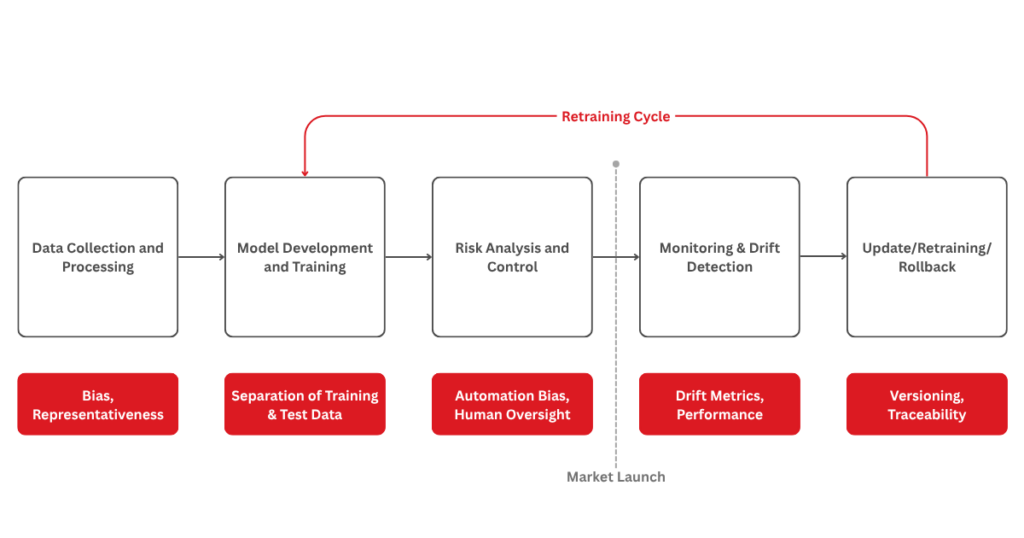
- Risk management does not end with approval: Monitoring, drift detection, controlled updates, retraining, and rollback must already be incorporated into the risk management plan.
1. Significance of ISO/TS 24971-2:2026
ISO/TS 24971-2:2026 is the first standalone specification to specify the application of the risk management process in accordance with ISO 14971 to artificial intelligence, particularly to products incorporating machine learning algorithms.
This is an important development for manufacturers of AI-based medical devices and IVDs. While the requirements for risk management are well-established, their practical implementation in ML-based systems raises new questions:
- How should bias be addressed?
- How do you assess drift and dataset shift?
- How do you integrate monitoring, retraining, and rollback into risk management?
- How do you address automation bias—that is, the human tendency to blindly trust the recommendations and decisions of automated systems or algorithms—as well as misuse and a lack of transparency?
The standard does not answer these questions with an entirely new risk
2. Scope of ISO/TS 24971-2:2026
This Technical Specification applies to manufacturers of medical devices and IVDs with machine learning components.
This includes, in particular, medical device software with machine learning (MLMD), including AI-based IVD software with machine learning algorithms, as well as traditional medical devices with integrated machine learning functionality.
The standard therefore affects more than just data scientists or software developers. Among others, the standard is also relevant for:
- Regulatory Affairs
- Quality Management
- Risk Management
- Clinical / Performance Evaluation
- Usability / Human Factors
- Post-Market Surveillance
The standard covers the entire product lifecycle. It therefore ranges from hazard and risk analysis through risk control to surveillance, updates, and rollbacks.
ISO/TS 24971-2:2026 is a technical specification and not a directly legally binding regulation. Nevertheless, it is highly relevant for manufacturers. This is because it
- specifies the application of ISO 14971 to ML-based medical devices,
- can be understood as reflecting the state of the art, and
- is likely to be used by Notified Bodies and regulatory authorities as an important interpretive guide.
For manufacturers subject to the MDR and IVDR, this means that the standard is not automatically mandatory. In practice, however, it is likely to quickly become an important frame of reference.
3. The Key Points of ISO/TS 24971-2
The key point can be summarized simply:
ISO 14971 continues to apply to AI-based medical devices that use machine learning—but manufacturers must apply it in a way that is specific to ML.
ISO/TS 24971-2:2026 does not, therefore, replace traditional risk management. Rather, it provides specific guidance where machine learning introduces new or different types of risks. This is precisely what makes it valuable.
The standard remains consistent with the logic of ISO 14971. However, it supplements it by addressing the specific characteristics of machine learning in medical devices.
a. ML Risk Management is More Than Just Software Risk Management
As is well known, risk management is a team effort. For the ML-specific risk management process, manufacturers need more than just software expertise. They also require expertise in:
- Data quality and representativeness
- Bias
- Typical ML error modes such as drift, dataset shift, or OOD inputs
- AI-specific usability risks
- IT/platform risks, cybersecurity, and data integrity
- Clinical workflow integration
b. Intended Use and Misuse Must be Described in an ML-Specific Manner
The standard requires that manufacturers specifically address risks typical of ML. These include, for example:
- Misinterpretation of scores or classifications
- Overreliance on the AI output
- Use outside the validated population or conditions
- Unclear limits of model performance
- Incorrect interpretation of uncertainty or confidence
- Misunderstandings due to a lack of transparency
c. Safety-Relevant Characteristics go far Beyond Accuracy
Safety-relevant characteristics include more than just accuracy and performance. The following are also important:
- Input data requirements
- Limitations of the target population
- Calibration and thresholds
- Known error scenarios
- Dependencies on the cloud, connectivity, or upstream systems
d. Risks Must not be Reduced to Model Errors
The standard emphasizes that manufacturers must not limit their analysis to model errors alone. Traditional risks also remain relevant, for example:
- Software and IT errors
- Usability issues
- Cybersecurity
- Data management
- Runtime environment
- Presentation of diagnostic information
e. Risk Assessment is Often Uncertain in ML
If the probability of a harm occurring cannot be reliably estimated, the assessment should be based on the severity of the potential harm. The standard also recommends additional evidence, such as through:
- Usability evaluations
- Analysis of critical user tasks
- Assessment of the representativeness of training and test data
- Robustness and subgroup analyses
f. Risk Control Begins with Data, Development, and Use
The specification lists typical ML-specific risk control measures. These include, in particular:
- Data quality
- Separation of training and test data
- Realistic input constraints
- Human oversight and intervention mechanisms
- Plausibility checks and alerts
- Transparent warnings, usage limits, and elements of explainability
g. PMS, Monitoring, and Controlled Changes are Central
The standard explicitly considers risk management beyond the point of placing the device on the market. Manufacturers should specify in the risk management plan
- how performance will be monitored,
- whether drift monitoring is required,
- when updates, retraining, or rollbacks will be necessary,
- and how versioning and traceability will be ensured.
h. Bias, Transparency, Explainability, and Autonomy are Relevant to Safety
The standard does not treat these topics as secondary aspects. They can significantly influence the safety profile and residual risk of an ML-based medical device.
4. Structure of the Standard
The structure is closely modeled after ISO 14971. This makes sense because manufacturers are not required to implement a parallel AI risk management system.
The main chapters are:
- Scope
- Normative references
- Terms and definitions
- General requirements for the risk management system
- Risk analysis
- Risk evaluation
- Risk control
- Evaluation of overall residual risk
- Risk management review
- Production and post-production activities
The annexes are particularly valuable:
- Annex A: Explanation of bias
- Annex B: Examples of hazards and hazardous situations
- Annex C: The checklist helps identify safety-related characteristics and hazards and can be used as an AI-specific PHA checklist.
- Annex D: Valuable considerations regarding the degree of autonomy of MLMD
The annexes, in particular, are very helpful in practice. They provide manufacturers with food for thought regarding hazard analysis, intended use, and residual risk.
5. Recommendations for Manufacturers
In our view, manufacturers of AI-based medical devices and IVDs should now take at least the following steps:
a. Expand the Competency Model
- Data representativeness
- Clinical significance of the data
- Usability
- Cybersecurity
- Data governance
- Model development, including training, testing, verification, and validation
Ensure that the risk management team possesses the necessary competencies not only in terms of software expertise but also in the following areas:
b. Review the Intended Purpose and Misuse
Verify that the limits of the application are described clearly enough. Also, verify that potential misinterpretations of outputs are realistically addressed.
c. Expand the Threat/Risk Analysis
Consider specific event chains arising from, for example:
- Data errors
- Drift
- Misuse
- Connectivity issues
- Update errors
- Insufficient transparency
d. Conduct a Gap Analysis
Check your existing risk management system specifically for ML-specific gaps. To this end, the gap analysis should include the following risk objects in particular:
- Input data and data governance, including data collection, data preprocessing, data management, and data labeling, as well as all types of bias
- Model development, including model training, validation, and testing
- AI-specific application errors caused by, for example, high complexity of the user interface, misinterpretation of outputs, overreliance on AI, distrust of correct outputs, insufficient awareness of boundaries and limitations, and automation bias
- Deployment dependencies, such as cloud latency or connectivity requirements, to the extent that these affect the timely delivery or availability of results
- Post-deployment activities, particularly performance drift as well as controlled model updates, retraining, or rollback
e. Actively Shape the PMS
Use PMS as a safety tool, not just as a formal requirement. Define how performance, drift, and real-world usage patterns are monitored and evaluated, and how new hazard scenarios are identified early on.
5. Recommendations for Manufacturers
In our view, manufacturers of AI-based medical devices and IVDs should now take at least the following steps:
a. Expand the Competency Model
- Data representativeness
- Clinical significance of the data
- Usability
- Cybersecurity
- Data governance
- Model development, including training, testing, verification, and validation
Ensure that the risk management team possesses the necessary competencies not only in terms of software expertise but also in the following areas:
b. Review the Intended Purpose and Misuse
Verify that the limits of the application are described clearly enough. Also, verify that potential misinterpretations of outputs are realistically addressed.
c. Expand the Threat/Risk Analysis
Consider specific event chains arising from, for example:
- Data errors
- Drift
- Misuse
- Connectivity issues
- Update errors
- Insufficient transparency
d. Conduct a Gap Analysis
Check your existing risk management system specifically for ML-specific gaps. To this end, the gap analysis should include the following risk objects in particular:
- Input data and data governance, including data collection, data preprocessing, data management, and data labeling, as well as all types of bias
- Model development, including model training, validation, and testing
- AI-specific application errors caused by, for example, high complexity of the user interface, misinterpretation of outputs, overreliance on AI, distrust of correct outputs, insufficient awareness of boundaries and limitations, and automation bias
- Deployment dependencies, such as cloud latency or connectivity requirements, to the extent that these affect the timely delivery or availability of results
- Post-deployment activities, particularly performance drift as well as controlled model updates, retraining, or rollback
e. Actively Shape the PMS
Use PMS as a safety tool, not just as a formal requirement. Define how performance, drift, and real-world usage patterns are monitored and evaluated, and how new hazard scenarios are identified early on.
6. Conclusion
a. Our Assessment: Is ISO/TS 24971-2 Helpful?
Yes—and significantly so.
In our view, the Technical Specification is
- helpful because it addresses typical weaknesses in AI risk management,
- conceptually sound because it remains consistent with the logic of ISO 14971,
- practical because it considers data, usage, monitoring, and updates as an integrated whole.
A particularly positive aspect is that it does not artificially treat AI as a special case. Instead, it sensibly builds upon the well-known fundamental principles of risk management.
Of course, some aspects remain at a rather general level. The standard often convincingly states what manufacturers must consider, but does not always specify in detail how this should be implemented methodologically. This applies, for example, to drift metrics, monitoring design, or explainability in complex models. However, this restraint is understandable, as the methods are still evolving in many areas.
b. Summary
ISO/TS 24971-2:2026 is an important step forward for the risk management of AI-based medical devices and IVDs that use machine learning.
It clearly demonstrates that good risk management for ML does not end with model performance. The following factors are also crucial:
- Data quality and representativeness
- Misuse and overreliance
- Transparency and explainability
- IT and usage context
- Post-market surveillance
- Controlled updates and retraining
For manufacturers, the most important takeaway is:
Risk management for MLMD involves data, system, usage, and lifecycle management.
The AI/ML experts at the Johner Institute ensure that manufacturers of medical devices and IVDs can quickly develop and obtain approval for their products in compliance with the law. In doing so, they also take into account the requirements of the AI Act, ISO/TS 24971-2, and other AI/ML-specific requirements.
Get in contact right away to learn how you, too, can develop your products quickly, compliantly, safely, and effectively.